Rust Is Quietly Replacing Python Inside AI Tools. Should Your Business Care?
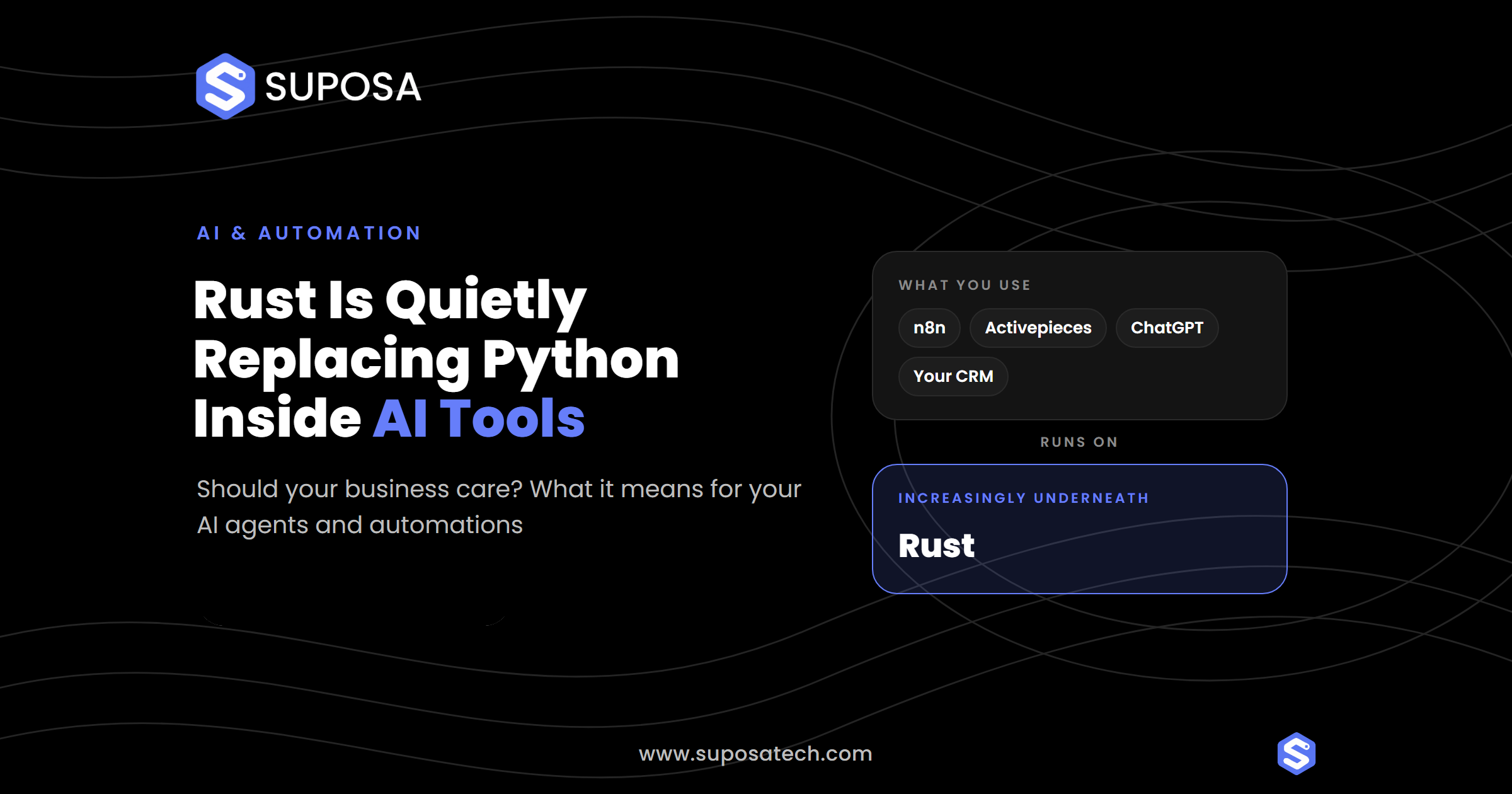
What the trend means for the AI agents and automations you run, in plain English.
The short answer
You may have seen headlines saying Rust is replacing Python in AI. That's only partly true. The tools your business uses are already changing because of it, and you probably didn't notice. That's the good news: you don't need to do anything dramatic. You do need to know what it means for speed, cost and the next time you click "Update."
What's actually happening
Python is the language most AI is written in. It's easy to use, which is why it became so popular. But it isn't the fastest, so tool makers are rebuilding the slow, busy parts of their products in Rust, a newer language known for being fast and very hard to crash.
A few signs of how far this has gone:
- The tools Python developers rely on are now built in Rust. The most popular new tools for installing and checking Python code (uv and Ruff) are written in Rust and run 10 to 100 times faster than the older ones.
- Big AI companies are investing in it. In March 2026, OpenAI announced it was buying Astral, the company behind those tools, and moving the team into its coding product.
- New AI agent tools are being built in Rust from day one. Many of the fastest-growing AI agent projects on GitHub in early 2026 were written in Rust, not Python.
- Even automation platforms are adopting it. n8n 3.0 rebuilt its image-editing step on a Rust-powered library.
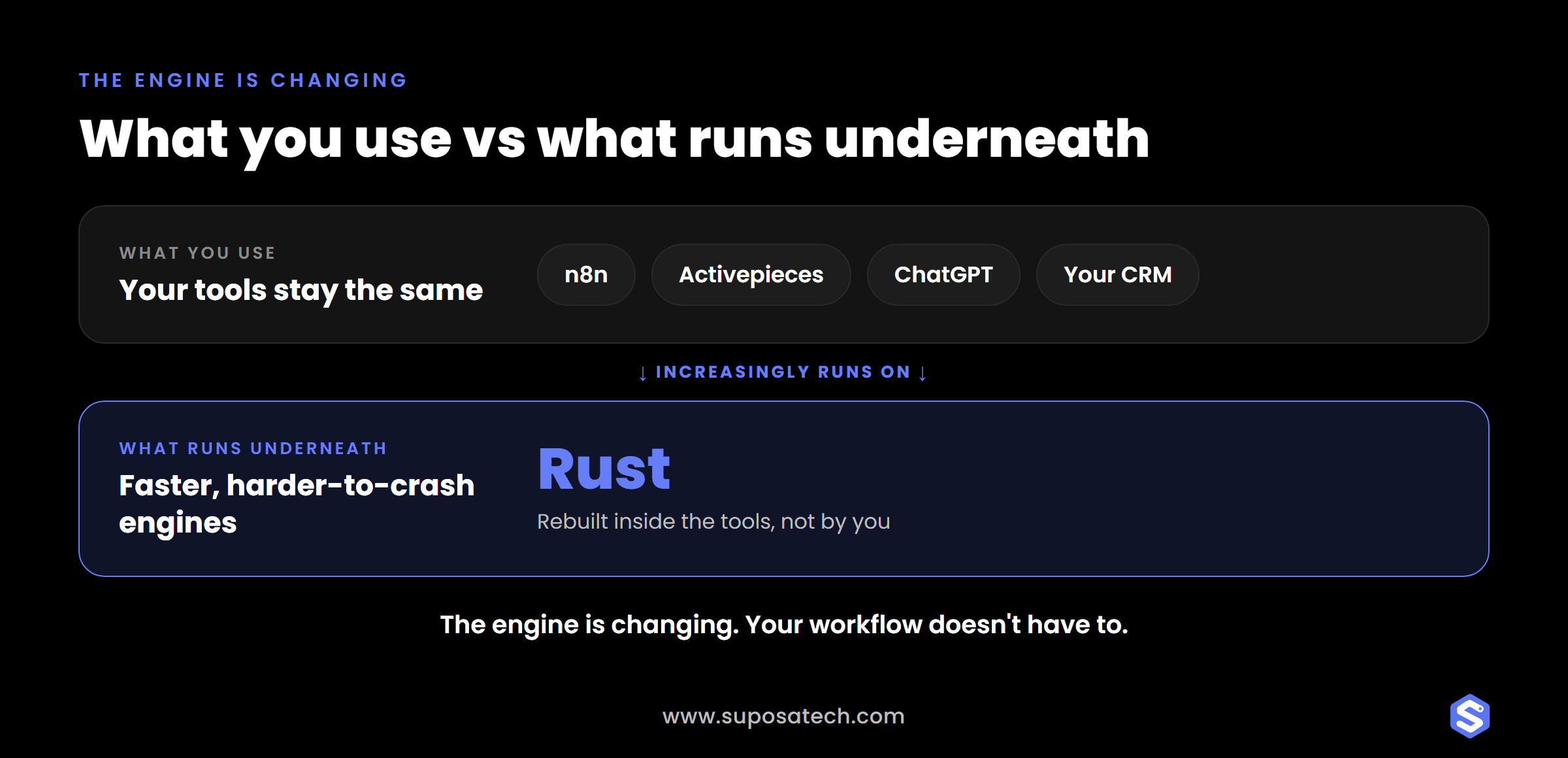
The pattern is simple: Python is still what people write. Rust is increasingly what runs underneath.
Who this affects
- Software developers: directly. They're learning new tools and, in some cases, a new language.
- Businesses that use AI agents and automations: indirectly, and mostly for the better.
- Businesses about to hire someone to build AI: in what they should (and shouldn't) ask for.
Should you worry?
No. Here's why.
Nobody is forcing you to rebuild anything. Python isn't going away, and neither are no-code platforms like n8n and Activepieces. The switch is happening inside the tools, so you get the benefits without changing how you work.
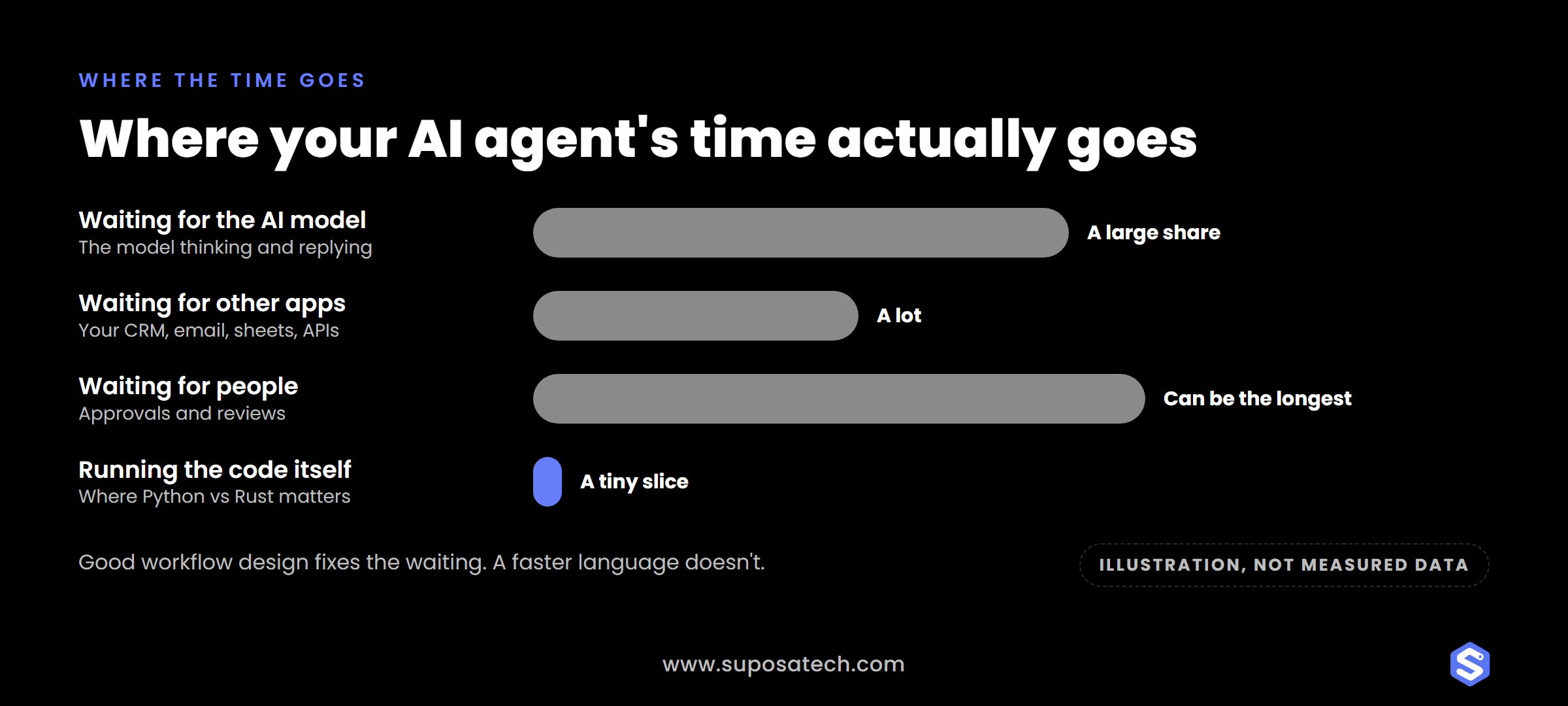
There's also a bigger point: for most business AI agents, the programming language is not what makes them slow or expensive. In the agents we build, most of the time is spent waiting: for the AI model to respond, for your CRM or email tool to reply, or for a person to approve something. A faster language doesn't fix any of that. Good workflow design does.
Where it does matter for you
1. Your tools will keep getting faster and cheaper to run. As more of the engine is rebuilt in Rust, AI and automation tools need less server power. If you self-host n8n or Activepieces, that can mean smaller servers and lower bills over time, as long as you keep them up to date.
2. Big updates can change how things behave. When platforms rebuild their engines, they sometimes ship major versions. n8n 3.0 is one, and n8n itself says it includes breaking changes. Workflows that run fine today could act differently after an upgrade. Test before you update anything your business depends on.
3. Don't choose technology because of hype. If someone pitches you "an AI agent rebuilt in Rust for speed," ask what problem it solves. For a high-volume system processing millions of records, it might be worth it. For lead follow-ups, invoice processing or customer support, a well-designed n8n or Activepieces workflow is usually faster to build, cheaper to change and easier for your team to understand.
What to do now
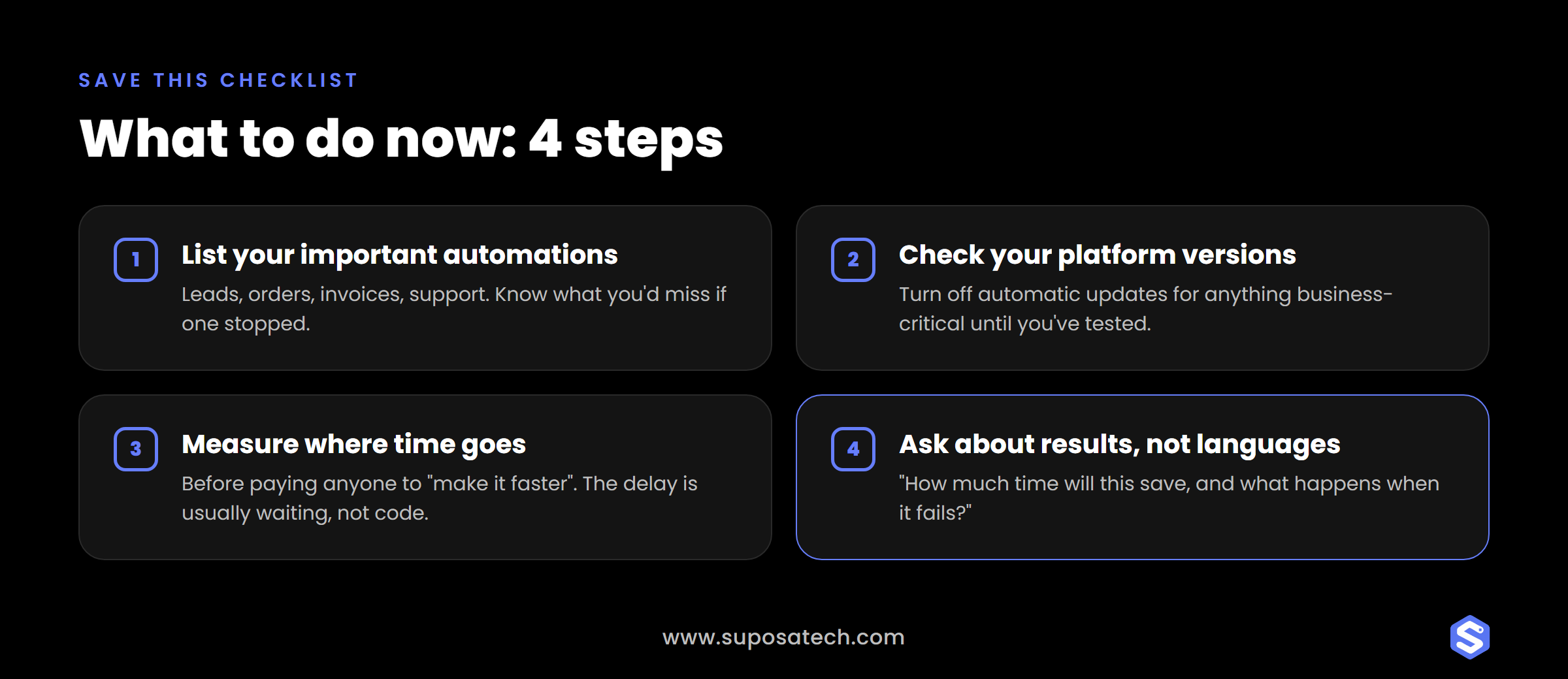
- List your important automations: leads, orders, invoices, support. Know what your business would miss if one stopped.
- Check your platform versions, and turn off automatic updates for anything business-critical until you've tested.
- Measure where your agents spend their time before paying anyone to "make them faster." Usually the delay is in waiting, not in the code.
- When you hire help, ask about results, not languages. "How much time will this save, and what happens when it fails?" matters more than "Is it Python or Rust?"
How Suposa can help
We build AI agents and automations in n8n and Activepieces for businesses that want results without the hype. You can see the kind of work we do in our case studies.
If you're not sure whether your automations are as fast, reliable or up to date as they should be, book a free 30-minute automation review. We'll look at your workflows, tell you what's worth improving, and tell you honestly if something is fine as it is.
P.S. Your customers will never ask whether your AI runs on Python or Rust. They'll only notice when it's slow, or when it breaks. If you'd rather find that out before they do, let's take a look together.
Author
Suposa Team
Content Writer
Post Details
Category
AI & Development
Published
November 28, 2026
Read Time
4 min read